

The platform allows you to control at a very granular level, when, and for how long, Members can see, respond to, and use Offers. The platform supports the following operational ranges that control these different aspects of the Offer usage life cycle:
-
Effectivity Period: This time range applies to the Offer, and controls when, and for long, the Offer is visible to Members on your website or app. The default setting is Always, but you can instead define a fixed time range, or a recurring time range.
-
Response Period: This time range applies to the Offer, and controls when, and for long, the Member is able to respond to the Offer, which then creates the Offer Response. The default setting is Same as Effectivity Period, but you can optionally define a fixed time range, or a relative period (relative to the Offer’s publish date).
-
Usage Period: This time range applies to the Offer Response, and controls when, and for how long, the Member is able to use the Offer Response. The default setting is Same as Effectivity Period, but you can optionally define a fixed time range, a relative period (relative to the Offer Response date), or "always" (meaning the Offer Response never expires).
The combination of the above operational time periods allows you to configure sophisticated marketing strategies.
For example, let’s say it’s currently January 1, and you want to advertise a special “Buy One Get One Free” Offer that runs from January 13-15. You could publish the Offer now and set the Effectivity Period to run from January 1 through 15. This configuration will make the Offer visible on your website or app immediately.
However, since you don’t want Members to actually be able to respond to the Offer yet, you would set the Response Period to span the promotional weekend, January 13-15. Members will see the Offer now, but they won’t be able to respond to it until the actual promotional weekend arrives.
Then, let’s say you want to give Members one week to actually use the Offer Response in a purchase. You could set a relative Usage Period to “one week from the Offer Response date.” In this manner, if a Member responds to the Offer on the Saturday of the promotional weekend, they would have until the following Saturday to use the Offer in a purchase.
Effectivity Period
To set the Effectivity Period for an Offer:
-
Select Campaigns from the top navigation bar, then select Offers > Offers from the side navigation menu. The Offers screen is displayed.
-
Search for and select the desired Offer (see Search for an Offer for more information on the available search options). The Offer Details screen is displayed, with the Definition tab selected by default.
-
In the top-right corner of the header area, click the Edit icon. The Edit Offer pop-up window is displayed.
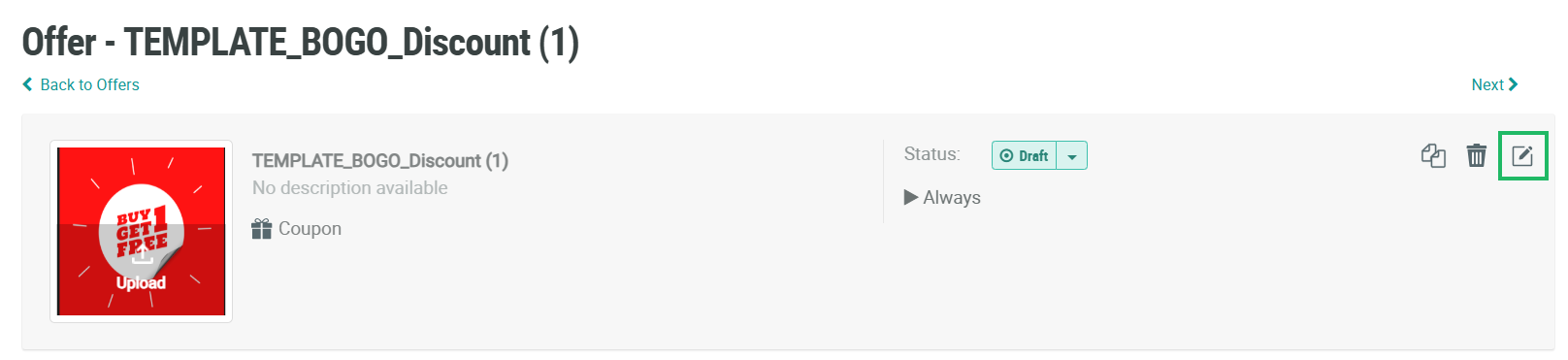
-
Next to Effectivity, select either:
-
Always: This Offer doesn't expire.
-
Scheduled: Enter a start date and end date, and select a time zone. Optionally, check Recurring to use a recurring schedule. Select the desired schedule from the Recurring Schedule drop-down menu, or define a new recurring schedule (see below for details on that process).
-
-
Click Save.
Response Period
The Response Period controls when a Member can respond to the Offer. The Response Period can either be a fixed date range (e.g., “July 1, 2025 - July 15, 2025”) or a relative date range (e.g., “three weeks after the Offer’s publish date”).
If you don't want to define a Response Period, select Same from the Select Period Type drop-down menu in the Effectivity Periods section. If this option is selected, the platform will use the Effectivity Period (see above) as the Response Period.
Fixed Response Period
To define a fixed Response Period:
-
On the Definition tab of the Offer Details screen, scroll down to the Effectivity Periods section.
-
Beneath Response Period, from the Select Period Type drop-down menu, select Fixed.
-
Click into the first date field, and select the start date and time for the Response Period.
-
Click into the second date field, and select the end date and time for the Response Period.
-
Optionally, check Recurring to use a recurring schedule. Select the desired schedule from the Recurring Schedule drop-down menu, or define a new recurring schedule (see below for details on defining a new recurring schedule).
-
Using the Time Zone drop-down menu, you can change the time zone for the Response Period to the one applicable to your business. In addition, if Members have a preferred location set within their Profile, the time zone for that location can be used; check Preferred Location Time Zone to enable this feature.
-
Click Save.
Relative Response Period
To define a relative Response Period:
-
On the Definition tab of the Offer Details screen, scroll down to the Effectivity Periods section.
-
Beneath Response Period, from the Select Period Type drop-down menu, select Relative. The platform will calculate the Response Period relative to the date when you publish the Offer.
-
If Members have a preferred location set within their Profile, the time zone for that location can be used; check Preferred Location Time Zone to enable this feature. Otherwise, the program setting’s time zone will be used.
-
Select the interval and a unit of time for the beginning of the time range. For example, 1 hour.
-
Select the interval and a unit of time for the end of the time range. For example, 2 weeks.
-
Click Save.
Usage Period
The Usage Period controls when a Member can use the Offer. The Usage Period can either be a fixed date range (e.g., “July 1, 2025 - July 15, 2025”) or a relative date range (e.g., “three weeks after the Member responds to the Offer”).
If you don't want to define a distinct Usage Period, from the Select Period Type drop-down menu, select either:
-
Same: If this option is selected, the platform will use the Effectivity Period (see above) as the Usage Period.
-
Always: If this option is selected, the Usage Period will not have an expiration date.
Fixed Usage Period
To define a fixed Usage Period:
-
On the Definition tab of the Offer Details screen, scroll down to the Effectivity Periods section.
-
Beneath Usage Period, from the Select Period Type drop-down menu, select Fixed.
-
Click into the first date field, and select the start date and time for the Usage Period.
-
Click into the second date field, and select the end date and time for the Usage Period.
-
Optionally, check Recurring to use a recurring schedule. Select the desired schedule from the Recurring Schedule drop-down menu, or define a new recurring schedule (see below for details on defining a new recurring schedule).
-
Using the Time Zone drop-down menu, you can change the time zone for the Usage Period to the one applicable to your business. In addition, if Members have a preferred location set within their Profile, the time zone for that location can be used; check Preferred Location Time Zone to enable this feature.
-
Click Save.
Relative Usage Period
To define a relative Usage Period:
-
On the Definition tab of the Offer Details screen, scroll down to the Effectivity Periods section.
-
Beneath Usage Period, from the Select Period Type drop-down menu, select Relative. The platform will calculate the Usage Period relative to the date when the Member responds to the Offer.
-
If Members have a preferred location set within their Profile, the time zone for that location can be used; check Preferred Location Time Zone to enable this feature. Otherwise, the program setting’s time zone will be used.
-
Select the interval and a unit of time for the beginning of the time range. For example, 1 hour.
-
Select the interval and a unit of time for the end of the time range. For example, 2 weeks.
-
Click Save.
Recurring Schedule
To define a new recurring schedule:
-
From the Recurring Schedule drop down menu, select Enter Schedule. The Repeat pop-up window is displayed.
-
From the Count drop-down menu, select a recurrence frequency of either Weekly or Monthly.
-
In the text field, enter the interval. Enter 1 if you want the schedule to run every week, or every month.
-
For a Weekly frequency, select one or more days of the week. For example, Tuesdays and Thursdays.
-
For a Monthly frequency, choose one of the following options:
-
Day of month: Select one or more days of the month. For example, the 15th and the 30th.
-
Day of week: Select one or more days of the week, for each of the four weeks within a month. For example, the second Wednesday of the month.
-
-
Click Confirm. The system adds the new schedule to the Recurring Schedule drop-down menu.
